
Career News
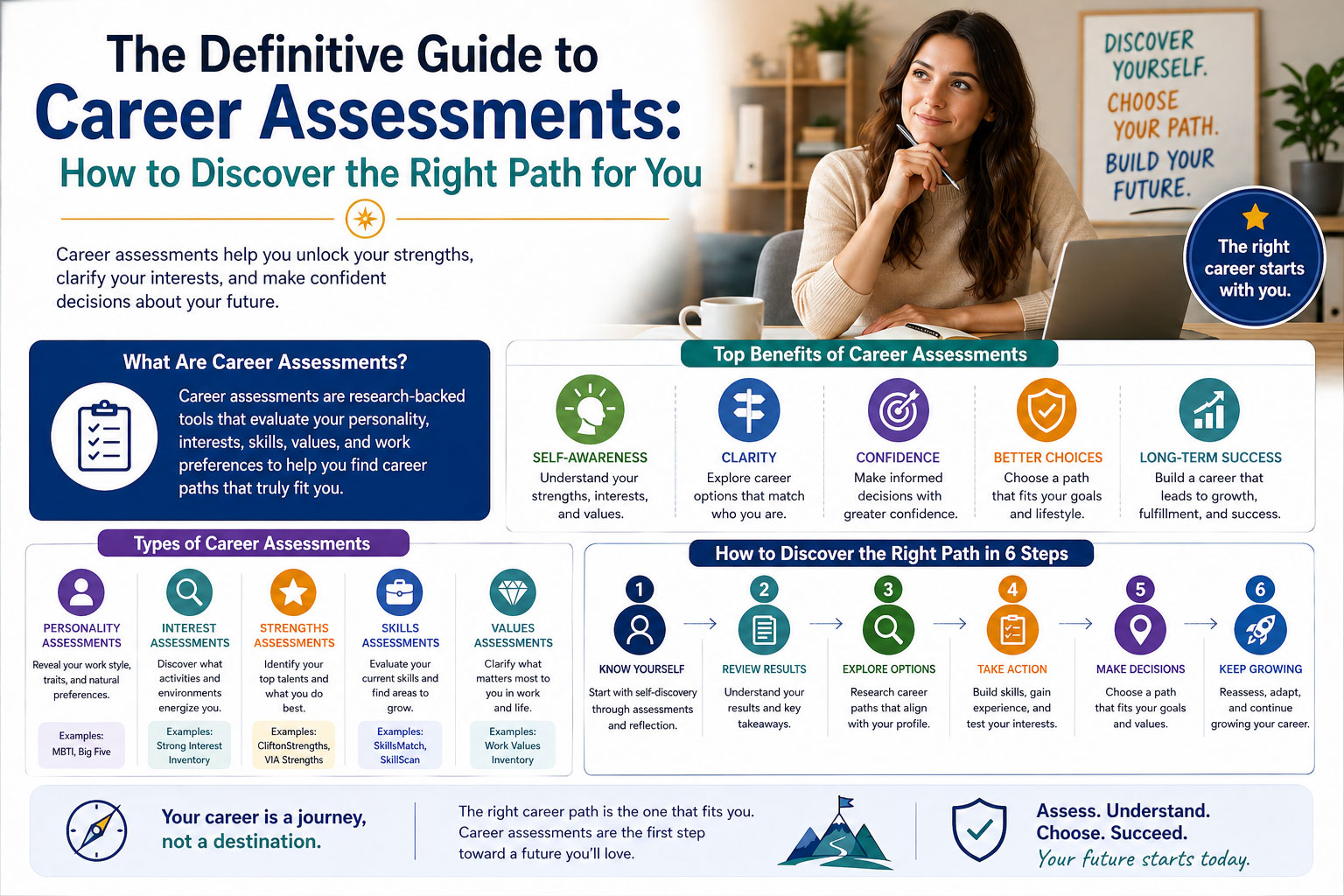
The Definitive Guide to Career Assessments: How to Discover the Right Path for You
Choosing a career, or deciding when to change one, is one of the most important and complex decisions a person will make. Yet most people rely on guesswork, external pressure, or outdated assumptions when making these choices.
That’s where career assessments come in.
Done correctly, career assessments provide structured, data-driven insight into who you are, how you think, what motivates you, and where you’re most likely to thrive—not just succeed.
This guide will walk you through:
- The different types of career assessments
- What each one measures
- How to use them effectively
- Common mistakes to avoid
- And how modern platforms are transforming how assessments are used
What Are Career Assessments?
Career assessments are tools designed to help individuals better understand:
- Their strengths and abilities
- Their personality and behavioral tendencies
- Their motivations and interests
- Their preferred work environments
The goal is simple:
Match the individual to roles, careers, and environments where they are most likely to perform well and feel fulfilled.
Not all assessments are created equal. Some measure ability. Others measure personality. The most powerful ones measure motivation, which is often the missing piece.
Why Career Assessments Matter More Than Ever
In today’s world:
- Careers are no longer linear
- People change roles multiple times
- Entire industries evolve or disappear
This makes alignment more important than ever.
Without alignment, people experience:
- Burnout
- Lack of engagement
- Poor performance
- Constant job switching
With alignment, people experience:
- Energy and motivation
- Faster growth
- Higher satisfaction
- Long-term success
The Main Types of Career Assessments
To fully understand yourself, you need to look at multiple dimensions.
- Motivation-Based Assessments (Most Important)
What They Measure:
- What drives you
- What energizes vs drains you
- The type of work you naturally enjoy
Why It Matters:
You can be capable of many things—but you’ll only thrive in environments that align with your motivation.
Example:
The MAPP® Assessment (Motivational Appraisal of Personal Potential) is one of the most widely used motivation-based assessments, helping millions understand where they will naturally perform at their best.
👉 Key insight:
Ability tells you what you can do. Motivation tells you what you will sustain and excel at.
- Personality Assessments
What They Measure:
- Traits (introversion/extroversion, openness, etc.)
- Behavioral tendencies
- How you interact with others
Popular Models:
- Big Five (OCEAN)
- Disc assessment
- MBTI (Myers-Briggs)
Why It Matters:
Personality influences:
- Communication style
- Leadership ability
- Team dynamics
However, personality alone does not determine career fit—it must be combined with motivation and interests.
- Interest Assessments
What They Measure:
- What subjects and activities you enjoy
- Areas of curiosity
Example: College Major & Degree-Path Alignment Assessment (Prospective or New College Students)
An exploratory assessment to help prospective or new college students identify best-fit major and degree-path clusters based on motivation, thinking style, work preferences, strengths, persistence, and environment preferences.
Another Example:
- Holland Code (RIASEC)
Why It Matters:
Interests often guide initial direction, especially for students or early-career individuals.
But interests can change—so they shouldn’t be used alone.
- Skills & Aptitude Assessments
What They Measure:
Cognitive Bias Awareness Assessment
This short assessment helps you notice common thinking shortcuts (cognitive biases) that can affect everyday choices. You’ll read brief situations and rate how much each statement matches what you would likely think or do.
- Problem-solving skills
- Verbal, numerical, or technical aptitude
Why It Matters:
These help answer:
“Can you do the job?”
They are widely used in:
- Hiring
- Education placement
- Technical roles
- Behavioral & Work Style Assessments
Example: Workplace Social Awareness (EQ) — Scenario-Based Assessment (Intermediate)
A 24-question, workplace-focused assessment of Social Awareness within Emotional Intelligence (EQ). Uses realistic scenarios to measure how well you notice emotional cues, read group dynamics, take others’ perspectives, and respond with empathy and tact in day-to-day collaboration.
Another Example: How You Work With Others: Team Collaboration Check-In
This check-in helps you understand how you usually work with others on a team. It looks at how you join in, share ideas, communicate, take on roles, handle feedback or disagreement, and adjust when plans change. There are no better or worse styles—just patterns you can notice and use to work more smoothly with a group.
What They Measure:
- How you approach work
- Decision-making style
- Leadership tendencies
Why It Matters:
These are critical for:
- Team fit
- Leadership development
- Organizational alignment
- Values-Based Assessments
What They Measure:
- What matters most to you
- Purpose, impact, lifestyle preferences
Why It Matters:
Misalignment in values is one of the biggest causes of dissatisfaction—even in high-paying roles.
The Biggest Mistake People Make
The most common mistake is relying on just one type of assessment.
For example:
- Personality alone → incomplete
- Interests alone → short-term thinking
- Skills alone → ignores fulfillment
👉 The best results come from combining:
- Motivation
- Personality
- Interests
- Skills
- Values
How to Use Career Assessments Correctly
Assessments are tools, not answers.
Here’s how to use them effectively:
- Look for Patterns, Not Single Results
No single score defines you.
Instead:
- Look for recurring themes
- Identify consistent strengths and preferences
- Combine Data with Reflection
Ask yourself:
- Does this feel accurate?
- Where have I seen this in my life?
- Test in the Real World
Insight without action is useless.
- Try roles
- Take on projects
- Experiment
- Revisit Over Time
People evolve.
What fit you 5 years ago may not fit today.
The Rise of AI in Career Assessments
Traditional assessments were static.
You took a test → got a report → and that was it.
Today, AI is changing everything.
What AI Adds:
- Interactive insights
- Personalized explanations
- Dynamic career recommendations
- Real-time Q&A about your results
Instead of reading a report…
You can now interact with your results like a conversation.
The Future: Platforms, Not Just Assessments
The next evolution isn’t just better assessments—it’s assessment ecosystems.
Platforms that combine:
- Multiple assessment types
- AI-powered insights
- Career matching tools
- Custom assessment creation
- Marketplace access
Introducing the Assessment.com Platform
One of the most advanced platforms emerging in this space is Assessment.com.
It brings together everything in one place:
Assessment Marketplace (100+ Assessments)
- Access a growing library of nearly 100 assessments
- Covering career, personality, skills, leadership, and more
- A majority are free to use
This allows users to:
- Explore multiple dimensions
- Compare results
- Gain a more complete picture
AI Assistant
- Interact with your results
- Ask career questions
- Generate insights and action plans
Assessment Builder (Manual + AI)
- Create your own assessments
- Customize for specific use cases
- Use AI to generate questions and reports
Who Should Use Career Assessments?
Individuals
- Career discovery
- Career change
- Personal growth
Students
- Choosing majors
- Exploring career paths
- Early direction
Businesses
- Hiring decisions
- Talent development
- Role alignment
Coaches & Consultants
- Deeper client insights
- Structured guidance
- Scalable services
When Should You Take a Career Assessment?
The best times:
- Entering the workforce
- Considering a career change
- Feeling stuck or unfulfilled
- Preparing for leadership roles
- Looking at Colleges Degree/Major Planning
- Re-entering the workforce
Final Thought: It’s Not About the Test—It’s About Alignment
Career assessments don’t give you a job.
They give you clarity.
And clarity leads to better decisions.
The goal isn’t to find:
“What should I do?”
It’s to understand:
“Where will I thrive?”
Because when you align:
- Your motivation
- Your strengths
- Your personality
- Your values
Everything changes.
Start Exploring
If you’re serious about making better career decisions, don’t rely on one test.
Explore multiple dimensions.
Use modern tools.
We’re excited to announce the launch of the new Assessment.com platform, a powerful evolution that brings together the globally trusted MAPP® assessment, an AI-powered assistant for real-time insights, and a growing Assessment Marketplace featuring nearly 100 assessments (many free). The platform now also enables you to build, host, and monetize your own assessments—either privately for your clients or globally through the marketplace, making it easier than ever to turn insights into action and opportunity.
👉 Get started with free access today and explore everything the platform has to offer: https://www.assessment.com
And take advantage of platforms like Assessment.com, where you can access a wide range of assessments over 50 for free and begin building a clearer, more confident path forward.