
Career News
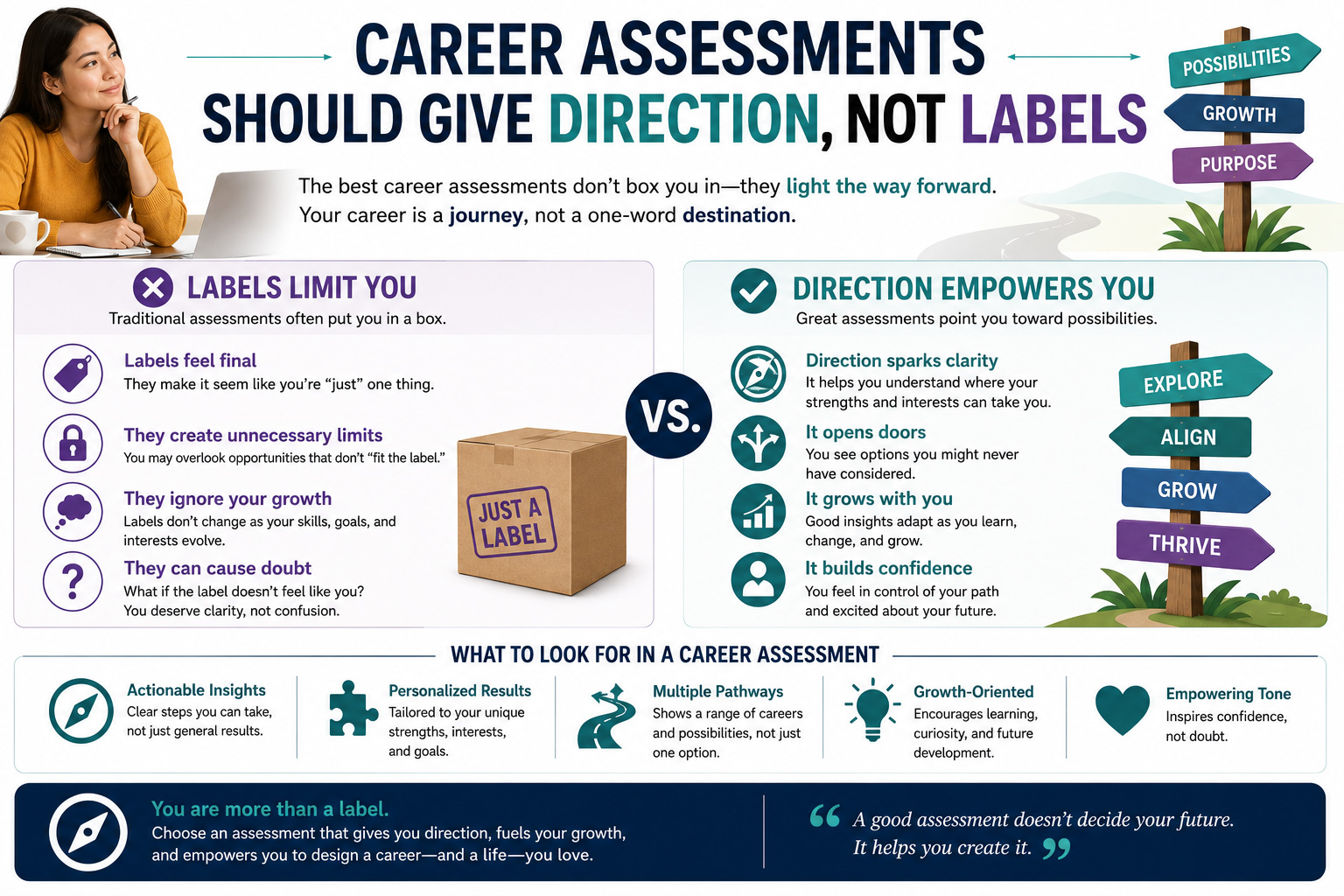
Opinion: Career Assessments Should Give Direction, Not Labels
Career assessments can be incredibly helpful, but only when they are used the right way.
Too often, people approach assessments hoping for one simple answer. They want the assessment to tell them exactly what career to choose, what major to declare, what job to pursue, or what kind of person they are. They want certainty. They want a label.
But that is not what the best assessments should do.
In my view, a strong career assessment should not reduce a person to a single job title, personality type, or rigid category. It should help people understand themselves more clearly, explore possible directions, compare the pros and cons of different paths, and make better decisions.
A good assessment should be a compass, not a cage.
It should provide direction, not a final verdict.
The Problem With Label-Based Assessments
Some assessments are built, marketed, or interpreted in a way that encourages labeling. They may tell someone they are a certain “type,” suited for one narrow category, or destined for a particular career path.
That may feel useful in the moment because labels are easy to understand. They simplify complexity. They give people language. They create a sense of order.
But labels can also be limiting.
A person is rarely just one thing. Someone may have interests in communication, creativity, leadership, analysis, service, and entrepreneurship all at the same time. Another person may have a strong technical orientation but also enjoy teaching, mentoring, or consulting. A student may seem aligned with healthcare, but within healthcare there are hundreds of very different paths.
A label can close the door too early.
It can cause someone to think, “This is what I am,” instead of, “This is one direction worth exploring.”
That distinction matters.
The goal of a career assessment should not be to put people in boxes. The goal should be to help them see patterns, possibilities, and better questions.
Why One Career Answer Is Usually Not Enough
Career decisions are too personal and too complex for one assessment to provide a single final answer.
A career choice involves many factors, including:
- Motivation
- Interests
- Skills
- Education
- Personality
- Work style
- Values
- Lifestyle goals
- Salary expectations
- Geography
- Family responsibilities
- Job market demand
- Training requirements
- Work environment
- Long-term opportunity
No assessment can fully account for all of that in one label.
A result may say someone is a strong fit for teaching, but that does not mean classroom teaching is the only path. The deeper pattern may be that the person enjoys explaining, guiding, mentoring, communicating, organizing information, or helping others grow.
That same pattern could point toward many possible directions:
- Teacher
- Corporate trainer
- Career coach
- Instructional designer
- Academic advisor
- Curriculum developer
- Learning and development specialist
- Education consultant
- Customer success trainer
- Youth program leader
The label “teacher” may be one useful clue, but the direction behind the label is much more valuable.
That is what good assessments should reveal.
Direction Is More Useful Than Prediction
The best career assessments do not pretend to predict a person’s entire future.
They help users understand where to look.
Direction is more useful than prediction because it gives people room to explore. It allows someone to say:
- These career areas may fit me.
- These types of tasks may energize me.
- These environments may be better for me.
- These paths may be worth researching.
- These options may have tradeoffs.
- These roles may not fit me as well.
- These questions are worth asking before I commit.
That is practical guidance.
A career assessment should help someone become a better decision-maker. It should not ask them to outsource their decision to a test result.
This is especially important for students, career changers, job seekers, and people who feel stuck in work that no longer fits. They often do not need a label. They need a better way to think.
A Career Assessment Should Start a Conversation
One of the greatest values of a good assessment is that it creates better conversations.
A student can bring results to a parent, counselor, or advisor and say, “Here are the directions that seem to fit me. Which majors connect to these paths?”
A career changer can bring results to a coach and say, “These are the types of work I seem motivated by. How can I move toward them realistically?”
A job seeker can use results to evaluate job descriptions and say, “This role sounds interesting, but does the daily work actually fit how I like to operate?”
A manager can use assessment insight to ask, “Are we using this person in a way that aligns with their strengths and motivations?”
The best assessments do not end the conversation. They improve it.
Labels often end conversations too early.
Direction keeps the conversation open and productive.
The Best Assessments Show Both Fit and Tradeoffs
A strong assessment should help users see not only what may fit, but also what may not.
That is where many simple career quizzes fall short. They offer a few suggested careers without explaining enough about the tradeoffs.
A better assessment helps users think through questions like:
- What parts of this career may I enjoy?
- What parts may drain me?
- What kind of environment would I be entering?
- What education or training would I need?
- How much time and money would this path require?
- What is the earning potential?
- What is the job outlook?
- What daily tasks would I actually perform?
- Are there related careers that may fit better?
- What would success in this path require from me?
This matters because a career can be a strong fit in one way and a weak fit in another.
A role may align with a person’s interests but not their preferred work environment. Another role may match their skills but not their motivation. Another may offer strong income but require daily tasks they are likely to dislike.
The best assessments help people see nuance.
They do not just say yes or no.
They help users compare options.
Motivation-Based Assessments Are Especially Valuable
In my opinion, motivation is one of the most important areas a career assessment can measure.
Skills matter. Interests matter. Personality matters. Experience matters. But motivation is often what determines whether someone will keep engaging with the work over time.
A person may be capable of doing a job but still feel drained by it every day. Another person may start with less experience but become successful because the work genuinely fits their motivations, and they are willing to learn, practice, and improve.
Motivation helps answer questions like:
- What kind of work will I want to keep doing?
- What tasks are likely to energize me?
- What responsibilities may feel meaningful?
- What kind of work may frustrate me over time?
- Where am I more likely to develop skill because I am motivated to engage?
That is why motivation-based assessments can be so useful for career exploration.
They help people understand not only what they can do, but what they may be naturally drawn to doing.
The MAPP™ Career Assessment as an Example of Doing This Well
A strong example of this approach is the MAPP™ Career Assessment, offered through Assessment.com.
The MAPP™ assessment is useful because it is not simply trying to slap a label on the user. It is designed to help people understand their motivations, preferences, and work-related patterns, then connect those insights to possible career directions.
MAPP™ stands for Motivational Appraisal of Personal Potential, and that focus on motivation is important. Instead of only asking what sounds interesting, the MAPP™ assessment helps users explore how they may prefer to work across areas such as interests, temperament, aptitude, people, things, data, reasoning, math, language, and other work-related traits.
What makes this approach valuable is that it can help users see broader career patterns. A user is not simply told, “You are this one thing.” Instead, they can explore multiple career paths, understand different areas of fit, and compare possibilities.
On Assessment.com, the MAPP™ Career Match experience can also help users match themselves against thousands of job titles and career paths, review overall and more granular fit, explore education pathways, and connect career insight to matching jobs.
That is exactly how career assessments should be used: not as a label maker, but as a decision-support tool.
No Assessment Should Make the Decision for You
This point is important.
No single assessment should make a career, education, or job decision for anyone.
Not the MAPP™ assessment. Not a personality assessment. Not an interest inventory. Not an aptitude test. Not an AI career tool. Not a school placement test. Not an employer screening tool.
Assessments can provide insight, but they should not replace judgment.
A person should use assessment results along with:
- Real-world career research
- Conversations with people in the field
- Salary and labor market data
- Education and training requirements
- Personal values
- Work experience
- Family and lifestyle considerations
- Coaching or advising
- Trial experiences such as internships, projects, volunteering, or shadowing where possible
Assessments are most valuable when they help people ask better questions and make better comparisons.
They should inform decisions, not dictate them.
Why This Matters for Students
Students are often pressured to make career and education choices before they fully understand themselves or the world of work.
They may choose majors based on family expectations, peer influence, perceived prestige, salary assumptions, or limited exposure to a few familiar professions.
A good assessment can help students step back and explore more thoughtfully.
Instead of asking, “What should I major in?” they can ask:
- What kinds of work fit my motivations?
- What career directions should I explore?
- Which majors connect to those directions?
- What daily tasks would I enjoy?
- What careers should I research before deciding?
- What paths may not fit me as well?
- What are the pros and cons of each option?
That kind of thinking can help students make more informed education decisions and reduce the risk of choosing a path that does not fit.
Why This Matters for Career Changers
Career changers often know what they want to leave, but not what they want to move toward.
They may feel burned out, bored, underused, stuck, or misaligned. But without better direction, they may jump from one poor fit into another.
A good assessment can help career changers understand the difference between escaping a bad situation and moving toward a better fit.
It can help them ask:
- What was missing from my current or past work?
- Which tasks gave me energy?
- Which responsibilities drained me?
- What strengths have I underused?
- What environments fit me better?
- Which new directions are realistic?
- What education or training would I need?
- What tradeoffs am I willing to accept?
For career changers, an assessment should not provide a fantasy answer. It should provide a clearer path for exploration and action.
Why This Matters for Job Seekers
Job seekers often search by title, salary, company, and location. Those factors are important, but they do not always reveal whether a job will be satisfying.
A good assessment can help job seekers evaluate opportunities more carefully.
Instead of applying to every job that looks available, they can look for roles that align with their motivations, work style, and long-term goals.
They can ask:
- Does this job fit how I like to work?
- Are the daily tasks aligned with my strengths?
- What parts of this job description excite me?
- What parts concern me?
- Is this role connected to one of my stronger career directions?
- What should I ask in the interview to understand fit?
This makes the job search more intentional.
The goal is not just to get any job. The goal is to find work that is more likely to fit.
Why This Matters for Coaches, Schools, and Employers
Assessments are not only useful for individuals. They can also help professionals and organizations have better conversations.
Career coaches can use assessments to guide clients through exploration, comparison, and planning.
Schools can use assessments to support advising, major selection, career readiness, and student retention.
Workforce programs can use assessments to help participants choose training paths and job directions that are more likely to fit.
Employers can use assessments to support role fit, development, internal mobility, coaching, retention, and hiring conversations when used responsibly.
In all of these settings, the assessment should not be treated as the final answer.
It should be the beginning of a better conversation.
Good Assessments Make People More Curious, Not Less
One of my favorite tests of a career assessment is this:
Does it make the user more curious about themselves and their options?
If the answer is yes, the assessment is probably useful.
If the assessment makes someone feel boxed in, discouraged, or reduced to a narrow label, it is probably being used poorly, even if the tool itself has value.
A good result should lead to exploration.
It should make a person want to learn more about related careers, compare options, talk to people, research job descriptions, consider education pathways, and reflect on what they want their work life to look like.
The best assessments create clarity, but they also create curiosity.
That combination is powerful.
A Better Way to Think About Career Assessment Results
Instead of asking, “What did the assessment say I am?” ask:
- What patterns do I see?
- What directions keep showing up?
- Which results feel accurate?
- Which results surprise me?
- Which options should I research?
- What tradeoffs should I consider?
- What do I want to test in the real world?
- Who should I talk to about these paths?
- What next step would help me learn more?
This shifts the assessment from a label to a tool.
That shift is important because careers are built over time. People grow. Industries change. Opportunities appear. Skills develop. Priorities shift.
A useful assessment should help people make a better next decision, not pretend to answer every question forever.
Career Assessments Should Be Compasses
The best metaphor for a career assessment is a compass.
A compass does not choose the destination for you. It does not walk the path for you. It does not guarantee that the road will be easy.
But it helps you orient yourself.
It helps you understand direction.
It helps you move with more confidence.
That is what career assessments should do.
They should help people move from confusion to clarity, from guessing to guided exploration, and from limiting labels to meaningful possibilities.
The MAPP™ Career Assessment is a strong example of this philosophy when used correctly because it emphasizes motivation, career direction, detailed fit, and exploration across many possible paths.
But the bigger principle applies to all assessments:
The purpose of an assessment should not be to define you.
The purpose should be to help you understand yourself well enough to make better decisions.
Final Thought
Career assessments are most powerful when they expand possibilities instead of narrowing them too soon.
They should help people understand their motivations, strengths, preferences, and options. They should help users compare career directions, evaluate tradeoffs, and ask better questions. They should support students, job seekers, career changers, coaches, schools, workforce programs, and employers in making more thoughtful decisions.
But they should not assign a person a permanent label.
No assessment should choose your future for you.
The right assessment should help you see your future more clearly, so you can choose it with greater confidence.