
Career News
By Tome Fierre
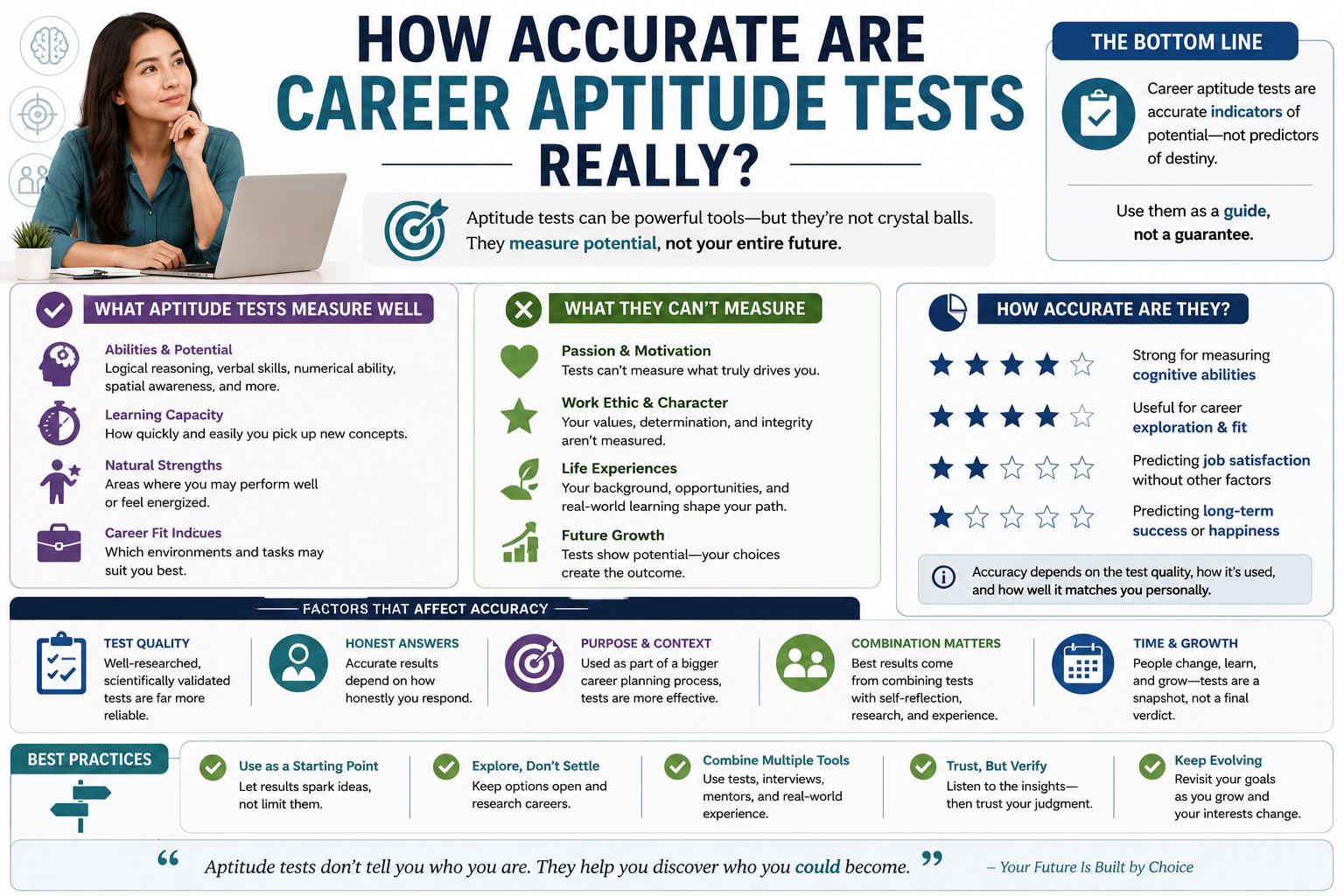
Career aptitude tests can be incredibly helpful, but they are often misunderstood.
Some people expect a test to tell them exactly what job to choose for the rest of their life. Others dismiss career tests completely because they once took a quick online quiz that gave them a strange or generic answer.
The truth is somewhere in the middle.
A good career aptitude test does not “predict your destiny.” It helps you understand your strengths, motivations, preferences, and patterns, then connects those patterns to career options that may fit you better than others.
That makes career aptitude tests useful, but only when you choose the right kind of assessment and use the results the right way.
The best tests help answer questions like:
What kind of work fits me best?
What motivates me?
What work environments help me succeed?
What careers should I explore?
What careers may drain me?
What jobs match my natural strengths?
What should I do next?
At Assessment.com, the worldwide-known MAPP Career Assessment helps people understand their motivations, strengths, and career matches. The Assessment.com marketplace also includes multiple career, personality, leadership, motivation, learning style, and personal growth assessments, many of them free.
So, how accurate are career aptitude tests really?
Let’s break it down in plain English.
What Does “Accurate” Mean in a Career Test?
When people ask whether a career aptitude test is accurate, they usually mean one of three things.
First, does the test describe me correctly?
Second, does it recommend careers that make sense?
Third, will it help me make a better decision?
Those are three different questions.
A test may describe your personality well but not give useful career direction. Another test may suggest careers that seem interesting but fail to explain why they fit. A stronger assessment does both. It helps you understand yourself and gives you useful direction.
Accuracy in career testing is not about one perfect answer. It is about whether the results help you see meaningful patterns and make better choices.
A career test is accurate when the report makes you think, “That explains a lot,” or “That is why I keep feeling stuck,” or “I had not considered that path, but it makes sense.”
That kind of clarity is valuable.
10 Questions and Answers About Career Aptitude Test Accuracy
- Are career aptitude tests accurate?
Good career aptitude tests can be accurate in identifying patterns in your interests, motivations, strengths, and work preferences. However, they should not be treated as a magic answer machine. The best use of a career test is to guide exploration, not make the final decision for you.
- Can a test really tell me what career I should choose?
A good test can suggest careers that may fit you, but it should not tell you that only one career is right. Strong career assessments give you a range of matches and help explain why those careers may fit. You should still consider salary, education, lifestyle, location, opportunity, and personal goals.
- Why do some career tests feel wrong?
Some tests are too short, too simple, or too focused on labels. A quick quiz may not understand enough about your motivations or work preferences to give meaningful results. Sometimes results feel wrong because the test measures what sounds interesting, not what actually fits your deeper motivations.
- What makes a career test more reliable?
A better career test asks thoughtful questions, measures more than one area of fit, explains results clearly, and connects your profile to real career options. It should help you understand both your strengths and your likely work preferences.
- What is the difference between aptitude and motivation?
Aptitude is what you may be naturally good at or able to learn. Motivation is what draws your interest and energy. Both matter. You can be capable of doing something and still dislike doing it every day. That is why MAPP focuses strongly on motivational fit.
- Are free career aptitude tests accurate?
Some free tests can be helpful for basic reflection, but quality varies. Free assessments can be a good starting point, especially when they are clear and well-designed. The Assessment.com marketplace includes many free assessments that can help you explore career fit, personality, motivation, and personal growth.
- Should adults take career aptitude tests?
Yes. Adults often benefit greatly because they have real work experience to compare against the results. An adult can look at a report and say, “That explains why I liked that role,” or “That explains why that job drained me.” This makes the results easier to apply.
- Can a career test help with a career change?
Yes. A good assessment can help you identify which parts of your past experience are worth carrying forward and which parts you may want to leave behind. It can also help you discover related careers you may not have considered.
- Can career tests help students choose a major?
Yes. If a student understands which careers fit their motivations and strengths, it becomes easier to choose a major, certificate, trade, training path, or degree. A career assessment can help reduce guesswork before making expensive education decisions.
- What should I do after taking a career aptitude test?
Look for patterns, not just job titles. Review your top matches, compare them to your current path, research a few careers, talk to people in those fields, and use an AI Career or College Coach to ask questions about your results. The test is the starting point. The action plan is where the value grows.
10-Bullet FAQ
- Career aptitude tests are most useful when they reveal patterns in strengths, interests, motivations, and work preferences.
- No career test should be treated as a final life decision, but a good one can help you make smarter choices.
- MAPP is different from many basic tests because it focuses on motivational fit and connects results to career matches.
- A test that gives only a label is usually less useful than one that explains what your results mean in real life.
- Adults often find career tests helpful because they can compare results to past jobs and real work experiences.
- Free career tests can be useful, and the Assessment.com marketplace includes many free options across career and personal growth categories.
- A strong career assessment should suggest several possible paths, not just one “perfect” job.
- Career tests can help with burnout, career change, job search direction, college major selection, and return-to-work decisions.
- The most accurate results usually come when you answer honestly, not based on what you think sounds impressive.
- The best career aptitude test is one that helps you understand yourself and take practical next steps.
Why Career Aptitude Tests Can Be Helpful, and Where They Can Fall Short
Career aptitude tests can be powerful because most people are too close to their own lives to see their patterns clearly.
You may know what jobs you have had. You may know what you studied. You may know what you are tired of. But you may not fully understand why certain work feels natural and other work feels frustrating.
A good career assessment can help connect the dots.
For example, someone may think they hate their career, when the real issue is the environment. Another person may think they need more money, when the deeper problem is that they feel underused. Someone else may believe they are not ambitious, when in reality they are simply in a field that does not match their motivations.
This is why the word “accuracy” can be tricky.
A career assessment is not accurate because it names one job and guarantees success. It is accurate when it reveals useful patterns and helps you make better decisions.
The best tests show you a direction. They do not remove your responsibility to think.
What Career Tests Can Do Well
A strong career test can help you understand what kinds of work may energize you, which roles may fit your natural tendencies, what environments may support your success, and what career paths are worth exploring.
It can also help you explain yourself better.
That matters in resumes, interviews, coaching sessions, college planning, and career transitions.
For example, instead of saying, “I want something different,” you may be able to say, “I am looking for a role where I can solve practical problems, work with people, and see a clear impact from my work.”
That is much stronger.
What Career Tests Cannot Do
A career test cannot know every detail of your life.
It cannot know your financial responsibilities, family needs, local job market, education budget, health, commute preferences, or personal timing unless you consider those things after the report.
It also cannot guarantee that a career will be perfect. A great career match can still be a poor fit if the company culture is bad, the manager is wrong, the hours are unreasonable, or the role is not what the job title suggests.
That is why a career test should be used as a guide, not a command.
A good report gives you direction. You still need judgment.
Example Story: The Person Who Thought the Test Was Wrong
Imagine someone named Rachel.
Rachel takes a career assessment and sees several roles related to training, advising, communication, and client support. At first, she thinks the results are wrong because she has always worked in finance.
But then she looks closer.
She realizes the part of finance she enjoys most is not spreadsheets or compliance. It is explaining complex ideas to clients, helping people make decisions, and building trust.
Suddenly, the results make sense.
The test was not saying, “Leave finance.” It was saying, “The human guidance part of your work may be where your strongest fit is.”
That insight could lead Rachel toward financial coaching, client education, training, customer success, advising, or leadership within financial services.
The result was not a random answer. It was a clue.
Example Story: The Burned-Out Manager
Now imagine David.
David is a manager in a fast-moving operations role. He is good at his job, but exhausted. He assumes he must not be cut out for leadership.
After taking an assessment, he sees a different pattern. He is motivated by planning, problem-solving, mentoring, and improving systems. But his current role is mostly urgent firefighting, constant interruptions, and pressure with little time to develop people or improve processes.
The issue is not that David cannot lead.
The issue is that his leadership role is structured in a way that conflicts with his strongest motivations.
That insight gives him options. He could look for roles in training, operations improvement, project leadership, process design, or team development. He does not need to abandon his experience. He needs to redirect it.
That is where a good career assessment becomes useful.
How to Get the Most Accurate Results
To get better results, answer honestly. Do not answer based on who you wish you were, what your parents expected, what your boss rewards, or what sounds impressive.
Think about what actually gives you energy.
Also, do not judge the results too quickly. Sometimes the most useful career matches are the ones you have not considered before. Look for themes across the results. Are they people-focused? Analytical? Creative? Practical? Structured? Independent? Service-oriented? Leadership-driven?
The patterns matter more than one job title.
If you take MAPP, review your top career matches, but also look at why those careers match. The “why” is often more valuable than the list itself.
Why MAPP Is a Strong Choice
The MAPP Career Assessment is a worldwide-known career assessment designed to help identify motivations, preferences, and career fit. It has been used by millions of people globally and is often used by individuals, coaches, schools, and organizations to support career decisions.
The strength of MAPP is that it focuses on what motivates you. That matters because motivation is often what separates a career you can do from a career that feels meaningful and sustainable.
MAPP helps you understand the kinds of tasks, environments, and career paths that may fit you best. For adults, students, job seekers, and career changers, that kind of insight can be extremely valuable.
The Assessment.com Marketplace Gives You More Ways to Explore
Career clarity often comes from looking at yourself from more than one angle.
That is why the Assessment.com marketplace includes multiple assessments across career, personality, leadership, motivation, emotional intelligence, communication, learning style, productivity, team role, wellness, and personal growth.
Many are free.
You might start with MAPP for career direction, then take a personality assessment to understand communication style, a leadership assessment to prepare for management, or a motivation assessment to understand what drives your follow-through.
Together, these tools can provide a more complete picture.
Using an AI Career or College Coach After the Test
One of the best ways to use assessment results is to ask better follow-up questions.
With an AI Career or College Coach, you can ask:
What do my results mean?
Why did these careers match me?
Which careers should I explore first?
Which careers should I avoid?
What majors fit my results?
What jobs should I search for?
How do I explain my strengths in an interview?
How can I pivot without starting over?
What skills should I build next?
This turns the assessment into an ongoing planning tool instead of a report you read once and forget.
Final Thoughts: Accurate Enough to Guide, Not Replace, Your Judgment
So, how accurate are career aptitude tests really?
The best answer is this: a good career assessment can be accurate enough to reveal meaningful patterns, point you toward better-fitting options, and help you make smarter decisions.
But it should not replace your judgment. It should improve your judgment.
The right assessment helps you stop guessing, understand yourself more clearly, and move forward with more confidence.
If you are ready to explore careers that fit who you really are, start with the worldwide-known MAPP Career Assessment at Assessment.com. Then explore the Assessment.com marketplace for additional career and personal growth assessments, including many free options.
Your future should not be based on a random quiz, pressure, or outdated advice.
It should be built on self-understanding, better information, and a plan that fits your life.